Find out more
Get the facts before you take the first step
Our latest in-depth articles

Browse our videos
Where does the training take place?
Comment Devenir Pilote d'Avion ?
How to pass airline selection
Frequently asked questions
Needing vision correction is not automatically a barrier to a career as an airline pilot. The requirement is distance visual acuity of 6/9 or better in each eye separately, with or without correction, and 6/6 or better binocular acuity. For an initial examination, refractive error must not exceed +6 dioptres. For more detail, we recommend contacting an approved Aeromedical Examiner (AME).
There is no height limit that would prevent you from obtaining a civil professional licence. If you are particularly short or tall, under 157 cm or over 200 cm, it is worth checking which aircraft types you can sit in comfortably and still reach all the controls. That will tell you whether your height would limit your career options.
It is not required. To join ESA's Airline Pilot programme, a high-school leaving certificate is enough, whatever the specialism. To join the BUT GEII / Airline Pilot programme, a general baccalaureate with a science specialism, or an STI2D technical baccalaureate, is required.
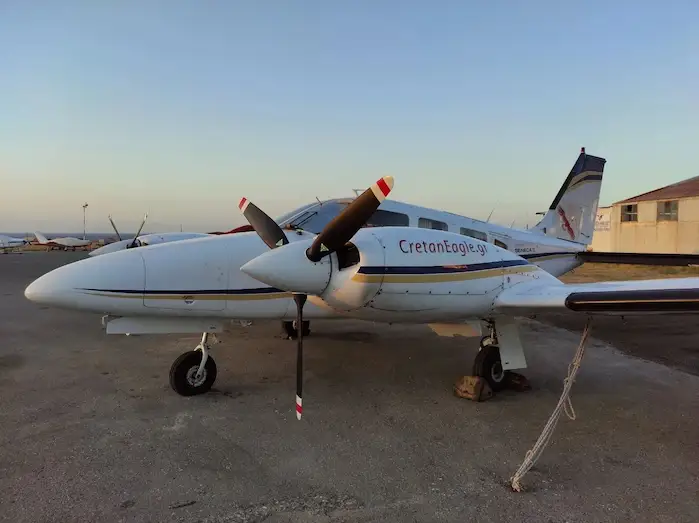
Apart from Air France's cadet programmes, nobody can guarantee a place with an airline. The same is true of any business or engineering school, however well regarded. What does matter is choosing a school that prepares you properly for airline selection, which is what we do at ESA for every student. The training environment counts just as much: that is why our students fly in Crete, immersed in English and operating from an international airport, so their flying experience is as close as possible to what awaits them.
Even past 25, and up to around 40, doors can still open at the airlines. Beyond 40 the plan looks different, but it remains possible: to give one example, the oldest student at the École Supérieure d'Aviation is 50.
If you want to become an airline pilot in France, you can sit the ENAC entrance exam via the preparatory-class route. But it is highly selective, with few places each year (13 places for 2,000 candidates). That is why, for students with a science baccalaureate, the dual BUT GEII / Airline Pilot programme is worth considering; it is chosen during the final year of school. For a faster route, we recommend our intensive course, which requires no previous experience and is taught in full immersion in Crete.
All courses delivered by the École Supérieure d'Aviation lead to a professional pilot licence. That covers airline pilots, business and private jet pilots, air ambulance pilots, and more.